Posts

Showing posts with the label Odisha

Promising results from a grassroot NGO: MLE pupils do better in Maths and English

Image
© Abhishek Scariya Visiting local NGOs sometimes reveals hidden gems. When I was at the Asha Kiran Society in Southern Odia last week, they talked about a study they did six years ago to compare children in their MLE classes with children who had only regular school inputs.  While studies of these may not be at the quality of a scientific  paper, they do help us by providing a peek into the positive impact Multilingual Education has. Here are some learnings from their  internal report.  The COVID-19 pandemic caused disruptions to global education, forcing primary school students to endure six to eight months without proper classes or structured educational inputs.  This provided Asha Kiran with an opportunity to do a unique study - to check for ‘retained learning’ - after 6 months of no formal educational inputs! In November 2022 the Asha Kiran Society in southern Odia conducted a small, quasi-experimental study to see whether the children who had gone through ...

MLE developments in India - International Mother Language Day 2026

Image
Happy International Mother Language Day 2026! There is lots to celebrate on this day, as many good things are happening. Yes, we realize that there are many challenges too, but on a day like this, let's look at some of the things that are happening in the different states and organizations! On the occasion of International Mother Language Day 2026, it is worth pausing to look at what is actually unfolding in India around multilingual education (MLE). This year’s theme from UNESCO, “Youth voices on multilingual education,” resonates strongly with ongoing conversations and developments in India shaped by NEP 2020 (National Education Policy) and the National Curriculum Framework. At the same time, recent evidence provides both encouragement and caution. UNESCO’s State of the Education Report for India 2025 (SOER) underscores that Mother Tongue–Based Multilingual Education (MTB-MLE) is foundational for inclusion and improved learning outcomes. However, the Teaching Learning Practices S...

Landscaping Study on Multilingual Education in India

Image
It is quite rare to get a broad snapshot on what is happening in a country with regards to Multilingual Education. I therefore thoroughly enjoyed participating in the recent webinar organized by the National Consortium on Multilingual Education in India (NCMLEI) about an MLE landscaping study that Tata Trusts did in India. In this blog, you can read a few insights, and I strongly recommend watching the whole webinar ! The NCMLEI #6 webinar presented by Akhila Pydah & Dr. Shailaja Menon showcased insights from a nationwide landscaping study on Multilingual Education (MLE)  by Tata Trusts between February and April 2025. This study drew from expert consultations, organisational interviews, field visits across four states, and extensive desk research, the study provided a systematic mapping of MLE efforts across India.  Key Findings Finding 1: Lack of a unified understanding of MLE- India lacks a clear, shared understanding of multilingual education (MLE). Literature define...

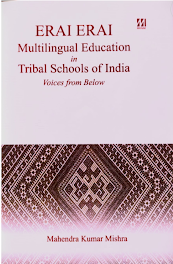
New book - MLE in Tribal schools in India by Dr. Mahendra. K. Mishra

Image
What could be more fun than reading a book authored by someone you know and about a topic you know about? The latest book by Dr. Mahendra Mishra focuses on Multilingual Education (MLE) in Tribal schools in India. I particularly liked the chapter on implementation as I remember so well how Dr. Mishra worked with our SIL colleagues Steve and Vicky Simpson, developing "Community Calendars" and "Theme Webs". It was around 2007 that I visited the project and saw the theme webs on the walls and the tribal teachers enthusiastically developing “big books”. That process is described on page 100 of the book which puts it literally and figuratively at the centre: This book is not just about the language issue in education but particularly shows a passion for the culture and folklore in which the children live and make that part of the teaching, books, and activities. In the concluding paragraph of that chapter Mishra writes "The community took a keen interest in sharing ...

Odisha expands their Multilingual Education program

Image
Odisha has for years been on the forefront of the multilingual education efforts in India. It is good to note that the government has decided to expand the program. According to this latest news report, the government of Odisha has announced that they will add 200 more teaching posts of Multilingual Education (MLE) in addition to the 200 posts already existing.. They will predominantly focus on working in districts with students from tribal and minority communities.  The government has also increased the number of languages under the promotion of  multilingual education from 10 to 16. The new languages to be included are Ho, Desia, Gadaba, Mundari, Sadri and Bhuyan.  ‘The expansion aligns with the state’s vision to preserve and revive tribal languages, fostering cultural heritage and inclusivity ,’  said secretary-cum-commissioner of the department Roopa Roshan Sahoo.( The Indian Express ) Currently  in Odisha, under the multilingual education programme, childr...

Oxfam Paper on the “Right to Mother Tongue-Based Education for Tribals in India”

Image
In my report on the Multilingual Education Conference in Bangkok in 2019, I mentioned a presentation from Anjela Taneja from Oxfam. I was very glad to note that Anjela has now taken the time to turn her findings into a paper so that we can all benefit from it. Upasana Lepcha has written below a helpful summary of the paper. Oxfam India has released a comprehensive paper on Multilingual Education (MLE) The Right to Mother Tongue-Based Education in Tribal India: A Comparative Perspective by Anjela Taneja. The paper  examines already existing Mother-Tongue-Based-Multilingual Education (MTB-MLE) programmes in India for tribal populations. It brings to light the gaps and challenges facing MTB-MLE and makes recommendations on how to overcome them. The first part of the paper addresses the severe underuse of the mother tongue as a medium of instruction in India and how this is especially crippling for the tribal children. Although tribals  constitute 8.6 percent of the total popul...