Posts

Showing posts with the label Indian classrooms

Key Insights from the Teaching Learning Practices Survey (TLPS) 2025

Image
Large-scale grassroots observations are rarely done and are a treasure for checking assumptions and developing teaching strategies. The Teaching Learning Practices Survey conducted by the Language and Learning Foundation has a special focus on language. This makes it very  relevant for the study of Multilingual Education. In this blog, we pick out the “jewels” in the treasure related to language. India’s classrooms are linguistically diverse. Children often come to school speaking a home language that is different from the school language. The Teaching Learning Practices Survey (TLPS) 2025 clearly shows this diversity by observing real classrooms across nine states. Instead of relying only on tests or reports, the survey went inside 1,050 classrooms to see how teaching and learning actually happen. This makes the findings especially important for people working on mother tongue–based multilingual education (MLE). The survey finds that 73% of teachers know the children’s home langua...

Smiling in Every Language: Reflections on MLE from Dr.Subir Shukla

Image
It was inspiring to listen to Dr Subir Shukla at the Lead India webinar recently. Subir challenged us that we tend to spend far too much energy and time on the 𝘦𝘹𝘵𝘳𝘪𝘯𝘴𝘪𝘤 dimensions of  multilingual education: developing textbooks, solving orthography issues, creating certificates, etc. We should spend more energy on the 𝘪𝘯𝘵𝘳𝘪𝘯𝘴𝘪𝘤 dimensions: using the languages of the children to connect with the children, to draw them out, to let them engage. That makes more difference in the learning results than getting the curriculum in the "right" languages. If that is the case, we might need to change the narrative around what MLE is about . Let us explore what Subhir had to say! At the September 2025 LEAD Community of Practice meeting, Dr. Subir Shukla challenged a persistent misconception about Multilingual Education (MLE): that MLE is seen as a project but should be more than a project or program — a part of the education system as a whole. While acknowledging the t...

Field and Policy insights on Multilingual Education from NORRAG Issue 11

Image
We usually talk about strategies and policies, but Aparna Dixit and Dhir Jhingran go deeper in their article on multilingual pedagogies in the latest NORRAG Special Issue on MLE. They state that teachers' opinions, values and attitudes play a critical role in making multilingual education work. I particularly like the concept of "reculturing": “ … a vital cultural transformation that supports teachers in adopting newer practices while they simultaneously question and realign their beliefs."  Two recent articles in NORRAG Special Issue 11 focus on multilingual education (MLE) in India, offering insights grounded in both field-level practice and national policy experience. Together, they reflect the complex linguistic realities and evolving strategies of implementing MLE in the Indian context. ( NORRAG is the Global Education Centre of the Geneva Graduate Institute and a global network  of education and training) In the article ‘Navigating Multilingual Pedagogies in ...

Embracing Multilingual Pedagogy: Insights from the School Education Conference 2025

Image
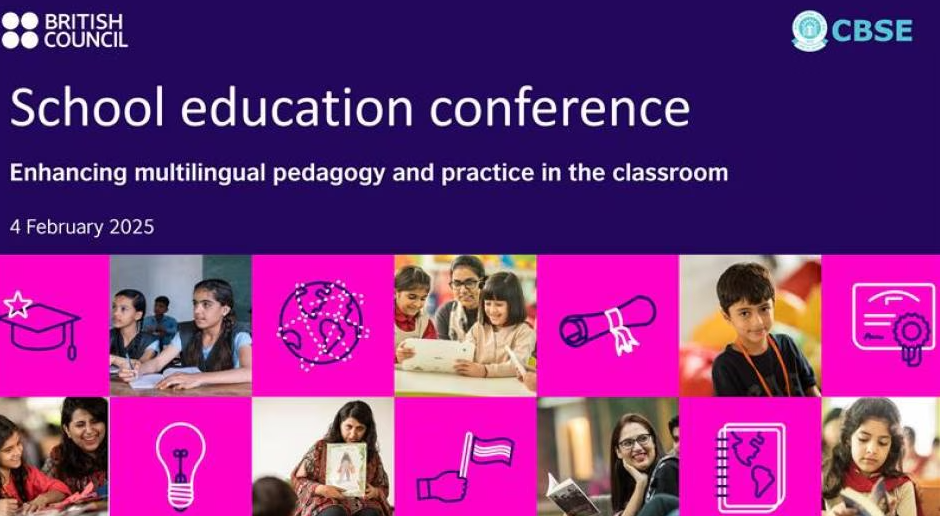
A joint conference between government, civil society and universities is always good for cross fertilisation. The   British Council focused the yearly School Education Conference this year on multilingual pedagogy and practice in school education. At these conferences a significant number of teachers attend: a good way to interact with the multilingual classroom realities! The School Education Conference 2025, held on February 4, 2025, in collaboration between the Central Board of Secondary Education (CBSE) and the British Council, was a pivotal event focusing on "Enhancing Multilingual Pedagogy and Practice in the Classroom." The conference aligned with India's National Education Policy (NEP) 2020 and the National Curriculum Framework for School Education (NCF-SE), emphasizing the transformative role of multilingual education in fostering inclusive and effective learning environments. Conference Highlights: Theme: The central theme revolved around integrating multil...