Posts

Showing posts with the label Language Learning Foundation

Key Insights from the Teaching Learning Practices Survey (TLPS) 2025

Image
Large-scale grassroots observations are rarely done and are a treasure for checking assumptions and developing teaching strategies. The Teaching Learning Practices Survey conducted by the Language and Learning Foundation has a special focus on language. This makes it very  relevant for the study of Multilingual Education. In this blog, we pick out the “jewels” in the treasure related to language. India’s classrooms are linguistically diverse. Children often come to school speaking a home language that is different from the school language. The Teaching Learning Practices Survey (TLPS) 2025 clearly shows this diversity by observing real classrooms across nine states. Instead of relying only on tests or reports, the survey went inside 1,050 classrooms to see how teaching and learning actually happen. This makes the findings especially important for people working on mother tongue–based multilingual education (MLE). The survey finds that 73% of teachers know the children’s home langua...

Field and Policy insights on Multilingual Education from NORRAG Issue 11

Image
We usually talk about strategies and policies, but Aparna Dixit and Dhir Jhingran go deeper in their article on multilingual pedagogies in the latest NORRAG Special Issue on MLE. They state that teachers' opinions, values and attitudes play a critical role in making multilingual education work. I particularly like the concept of "reculturing": “ … a vital cultural transformation that supports teachers in adopting newer practices while they simultaneously question and realign their beliefs."  Two recent articles in NORRAG Special Issue 11 focus on multilingual education (MLE) in India, offering insights grounded in both field-level practice and national policy experience. Together, they reflect the complex linguistic realities and evolving strategies of implementing MLE in the Indian context. ( NORRAG is the Global Education Centre of the Geneva Graduate Institute and a global network  of education and training) In the article ‘Navigating Multilingual Pedagogies in ...

PALASH Multilingual Education Program of Jharkhand

Image
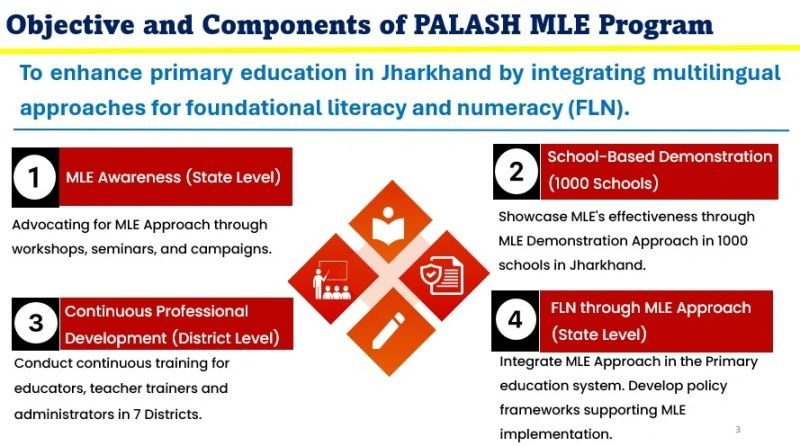
Jharkhand is a state full of tribal communities and therefore has a rich palette of languages. The state government is implementing the National Curriculum Framework  and has launched the PALASH Multilingual Education Program which aims at enhancing learning outcomes in all subjects by integrating children's first languages in primary education.  Good to note that they are consulting with Language Learning Foundation, UNICEF and other agencies. It will be interesting to watch where it will land in the spectrum between the "pedagogically ideal" and the "political feasible" when it comes to implementation.  The PALASH Multilingual Education Program launched by Jharkhand aims to improve access to education for tribal children by integrating mother tongue-based multilingual education (MTB-MLE). Tribal children often face educational challenges due to the gap between their home language and Hindi, the medium of instruction in most schools. The PALASH program address...

International Literacy Day 2024: Observations from Cameroon and India

Image
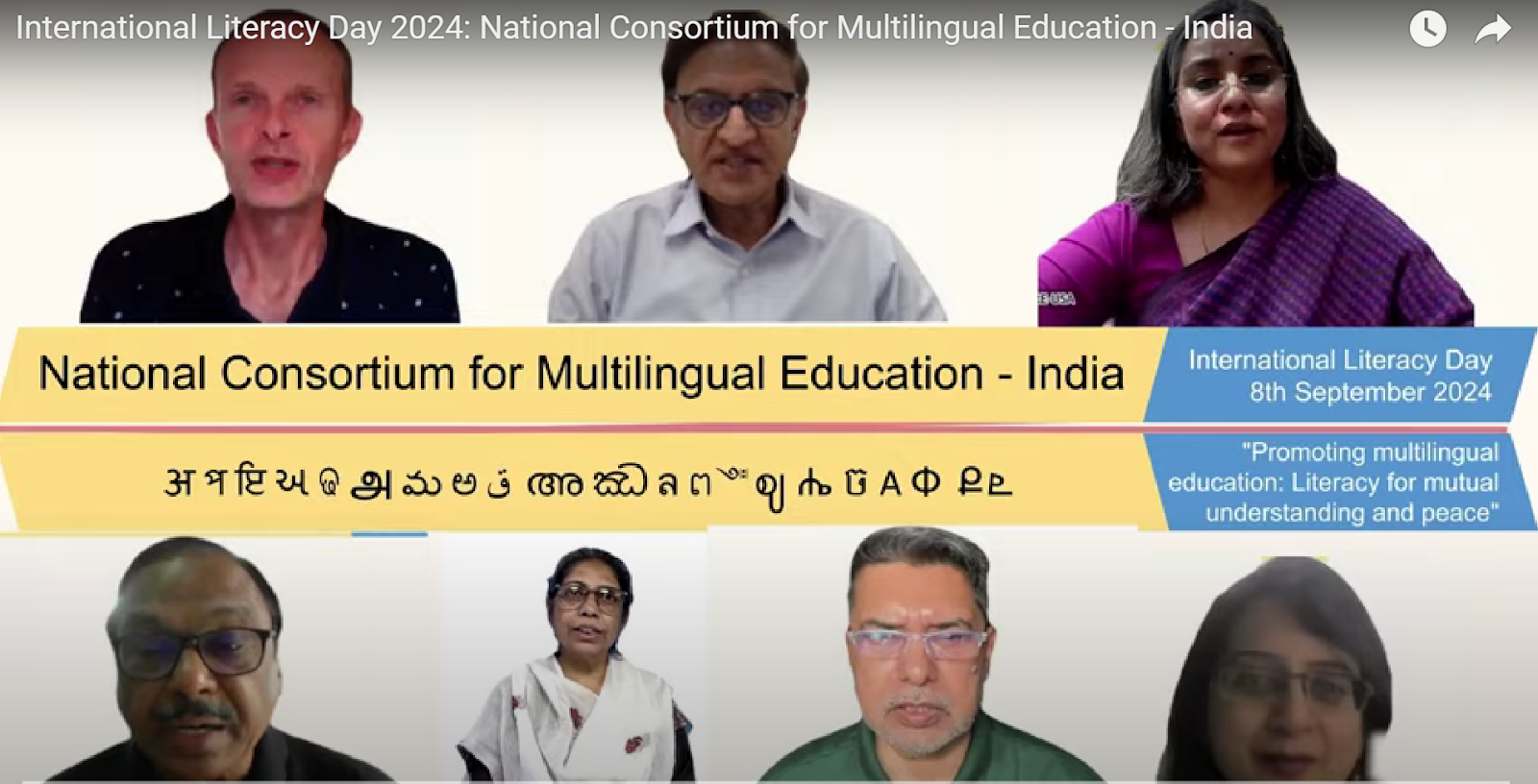
Congratulations on International Literacy Day! This year the focus was on multilingual education and therefore deserves a blog post! Both Cameroon and India have a lot of linguistic diversity. UNESCO chose Cameroon to celebrate and here in India it will be good to take note of what the government said. As a national MLE consortium we also made a brief video to get the perspective of civil society organisations. International Literacy Day (ILD) has been observed  since 1967 on the 8th of September. This day highlights the importance of literacy as a fundamental human right and its role in empowering individuals and advancing societies. In 2024, the theme centres on "Multilingual Education," emphasising the significance of learning in one's mother tongue or multiple languages for inclusive and equitable quality education. This year's theme resonates strongly with the goal of fostering linguistic diversity and promoting literacy in marginalised communities, particularly ...